
Tracker™ - Pendant Drop Tensiometer for Surface Tension, Interfacial Tension, and Interfacial Rheology
One drop. One method. The complete picture of your interface — from equilibrium through dynamics to rheology.
The TRACKER is built entirely around axisymmetric drop shape analysis (ADSA) — a first-principles method. A precisely formed pendant or rising drop is suspended from a capillary tip, and its profile is captured by a high-resolution imaging system. The shape of that drop is governed by the balance between gravitational and surface forces, and ADSA works by fitting the experimentally observed profile to a theoretical curve derived from the Young-Laplace equation. The surface or interfacial tension is the value that produces the best fit between the Laplacian curve and the measured drop shape. Because the theoretical curve comes directly from the fundamental physics — not from calibration against a reference liquid, not from an empirical model, and not from mechanical contact with the interface — the result is a first-principles determination of surface tension. This is what Erbil describes as an absolute measurement of surface and interfacial tension.
A first-principles measurement is inherently the most reliable measurement a scientist can make, because it does not depend on assumptions, reference standards, or empirical models that may or may not apply to the system under study. It depends only on the physics. And because ADSA is also a non-contact optical method — the interface is observed, never touched — there is no mechanical interaction with the surface, no probe or plate, and no physical artifact introduced into the measurement.
This is the only measurement methodology the TRACKER uses, and it is the only methodology TECLIS offers. That is a deliberate choice. Where other instrument manufacturers provide both force-based tensiometry (Wilhelmy plate, du Noüy ring) and optical methods, TECLIS builds exclusively around ADSA — because we believe it is the most versatile and most rigorous approach to interfacial characterization available.
Force-based methods have a well-established role in surface science, particularly for pure liquid systems at equilibrium. But they require physical contact with the interface, which inherently limits what can be measured and under what conditions. A single pendant drop, analyzed optically, can do what no force method can: measure surface and interfacial tension as a continuous function of time, capture adsorption and desorption kinetics in real time, apply controlled oscillatory perturbations to probe the viscoelastic response of the interface, and do all of this under ambient or extreme conditions of temperature and pressure — from the same platform, with the same drop, in the same experiment.
For you, this means every measurement the TRACKER produces traces back to fundamental physics — not to a calibration curve, not to a correction factor, and not to an empirical model. It is the most direct, most versatile, and most accurate path from your sample to the answer you need.
“The drop shape method is an absolute measurement of surface and interfacial tension.”
— Surface Chemistry of Solid and Liquid Interfaces, Professor H. Y. Erbil, Blackwell Publishing, 2006
Surface Tension and Interfacial Tension
At its most fundamental level, the TRACKER measures surface tension (liquid-gas) and interfacial tension (liquid-liquid) — both as single-point equilibrium values and as continuous functions of time. A pendant or rising drop is precisely formed at the tip of a capillary, and the TRACKER captures and analyzes its profile continuously, reporting the surface or interfacial tension at each time point from the moment the interface is created.
This time-resolved capability is what distinguishes the TRACKER from instruments that report only an equilibrium value. Many systems — particularly those containing surfactants, polymers, proteins, or mixtures — take seconds, minutes, or even hours to reach equilibrium. The path to equilibrium is often as informative as the equilibrium value itself, because it reveals how quickly surface-active species populate the interface, how they compete for adsorption sites, and whether the system reaches a true steady state or continues to evolve. The TRACKER captures all of this automatically.

Adsorption and Desorption Kinetics
Tracker Tensiometer Surfactant Adsorption and Desorption measurements
When a fresh interface is created, surface-active molecules begin migrating from the bulk solution to the surface. The rate at which they arrive, how they arrange themselves at the interface, and how the surface tension evolves during this process are the adsorption kinetics of the system. Desorption — the reverse process, in which molecules leave the interface — is equally important but often more difficult to measure.
The TRACKER measures both, in real time, by tracking the continuous evolution of surface or interfacial tension following interface creation or perturbation.
For more complex studies, the TRACKER offers two phase exchange modules that allow you to change the chemical environment of the interface without disturbing the drop itself. The dense phase exchange module replaces the liquid surrounding the drop or bubble — the continuous phase in the cuvette — while maintaining constant drop volume. The drop phase exchange module does the opposite: it replaces the liquid or gas inside the drop or bubble while keeping its volume constant. Both processes can be automated or manually controlled, and all measurements continue uninterrupted during the exchange.
This makes it possible to study sequential adsorption — for example, allowing one surfactant to establish itself at the interface and then introducing a second component to observe competitive displacement. It also enables the study of protein-surfactant interactions at interfaces, where a pre-adsorbed protein layer can be challenged by an incoming surfactant, and the resulting changes in surface tension and interfacial rheology can be followed in real time.
Interfacial Dilatational Rheology
Surface tension tells you about the state of the interface. Interfacial rheology tells you how it will behave.
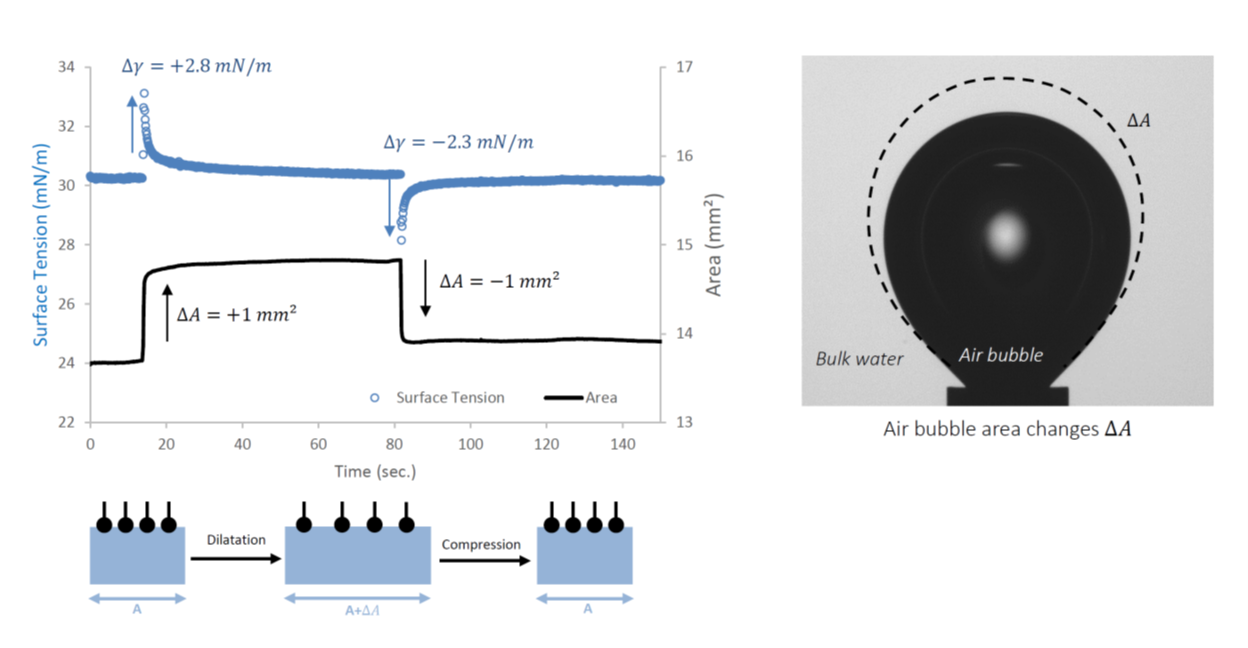
By applying controlled sinusoidal oscillations to the drop volume, the TRACKER periodically expands and compresses the interfacial area and measures the resulting change in surface tension. The ratio of the change in surface tension to the relative change in area defines the viscoelastic modulus (E), which can be separated into its elastic component (the storage modulus, E') and its viscous component (the loss modulus, E''). The TRACKER also determines the rigidity coefficient, which characterizes membrane-like interfaces — systems where the interfacial film behaves more like a solid than a liquid.
These properties are what determine whether a foam lamella will survive mechanical stress or rupture, whether an emulsion droplet will resist coalescence, and whether a thin film will recover after deformation. Two systems with identical equilibrium surface tension can have completely different viscoelastic moduli — and therefore completely different performance in any application involving mechanical disturbance.
The standard TRACKER performs oscillatory measurements using precise syringe-driven volume control. For applications requiring higher oscillation frequencies — up to 10 Hz — the piezoelectric module replaces the mechanical syringe with a piezoelectric ceramic actuator, providing the speed and precision needed to probe interfacial dynamics at shorter timescales. This is particularly relevant for fast processes such as spray coating, high-shear mixing, and rapid film formation, where the interface is deformed at frequencies that a mechanical syringe cannot reach.
Tracker Surface and Interfacial Rheology Measurement
Surface Pressure
The TRACKER can also control and measure surface pressure — the difference between the surface tension of a clean interface and the surface tension of the same interface with an adsorbed film. By precisely controlling the drop volume, the TRACKER compresses or expands the interfacial area, changing the surface concentration of adsorbed molecules and measuring the resulting change in surface tension.
This capability turns the pendant drop into a miniature Langmuir-type film balance. You can construct compression isotherms, determine exclusion pressures, and study the mechanical behavior of interfacial films at controlled surface pressures — all from a single drop requiring only microliters of sample.
For systems involving lipid monolayers, this is particularly powerful. The TRACKER allows you to build an interface with a known composition, compress it to a controlled surface pressure, and then probe its rheological properties at that pressure. You can study the sequential adsorption of one or several molecular species, observe how a pre-formed monolayer responds to the introduction of new components, and determine at what surface pressure a given molecule is excluded from the interface.
The pressure sensor module adds a complementary measurement: it captures the hydrostatic pressure above a bubble in liquid, or the internal pressure of a bubble in air, providing a direct measurement of the Laplace pressure. This is particularly useful for characterizing the transition from a fluid interface to a membrane-like film — the point at which the interfacial layer becomes rigid enough that it no longer behaves as a liquid surface.
When combined with the piezoelectric module, the pressure sensor also enables measurement of surface tension at high oscillation frequencies, providing an independent cross-check of rheological data obtained from drop shape analysis.
Critical Micelle Concentration (CMC)
The critical micelle concentration (CMC) is one of the most fundamental characterization parameters in surfactant science.
The critical micelle concentration (CMC) is the concentration at which surfactant molecules in solution begin to self-assemble into micelles, as aggregation becomes thermodynamically favorable. Below the CMC, surfactant exists predominantly as monomers (and sometimes small pre-micellar aggregates); above it, additional surfactant preferentially increases the number of micelles rather than the monomer concentration.
Surfactants lower surface or interfacial tension by adsorbing at interfaces. As bulk concentration increases, the interface accumulates surfactant until it approaches adsorption saturation. Around the CMC, the tension–concentration relationship typically shows a distinct change in slope: strong tension reduction below CMC, then a much weaker dependence above CMC because extra surfactant is “buffered” into micelles while the interface is near saturation.
In tensiometric terms, what you measure is a time-dependent tension γ(t) that relaxes toward an equilibrium value γ_eq as adsorption and reorganization proceed. A “CMC from tensiometry” is therefore an operational CMC: the concentration where the equilibrium (or defined quasi-equilibrium) tension reduction saturates under your specific conditions—temperature, electrolyte, impurities, gas/oil phase, and the time allowed to approach equilibrium. It typically tracks micellization, but it is not a universal constant unless these variables are tightly controlled and reported.
The classical signature is obtained by measuring γ_eq across a concentration series and plotting γ_eq vs log10(c). In Regime I (dilute), γ decreases strongly with log(c) as adsorption increases with concentration. In Regime II (near CMC), the slope progressively flattens (often broadened by non-idealities or mixed aggregation). In Regime III (above CMC), γ approaches a near-plateau value, γ_min, because additional surfactant mainly increases the micelle population rather than interfacial coverage.
The TRACKER automates CMC determination. The CMC module introduces surfactant solution in controlled, incremental concentration steps, measuring the equilibrium surface tension at each step and constructing the surface tension versus concentration curve from which the CMC is identified. The system can work with up to four different surfactant solutions in a single automated run, and the injected volume and concentration at each step are determined by an algorithm that optimizes the spacing of concentration increments to maximize the accuracy of the CMC determination. The drop volume is automatically adjusted at each concentration to maintain optimal drop shape for accurate surface tension measurement.

Tracker Tensiometer Critical Micelle Concentration (CMC) Measurement
Contact Angle and Wettability
The same optical platform and drop shape analysis methodology that the TRACKER uses for pendant and rising drops also supports sessile drop and captive bubble configurations for contact angle and wettability measurements.
In a sessile drop measurement, a liquid drop is placed on a solid surface, and the TRACKER analyzes the drop profile to determine the contact angle — the angle at which the liquid-gas interface meets the solid. In a captive bubble configuration, a bubble is captured beneath a solid surface immersed in liquid, and the contact angle is determined from the bubble profile. Both static and dynamic (advancing and receding) contact angles can be measured, providing information about contact angle hysteresis and the wetting behavior of the surface under realistic conditions.
Because these measurements use the same ADSA methodology as all other TRACKER measurements, they can be performed under the same range of environmental conditions — including elevated temperatures and pressures — using the same analytical rigor and the same software platform.

Elevated Temperatures and Pressures
Many real-world applications operate far from ambient conditions. Reservoir fluids, enhanced oil recovery processes, high-temperature food processing, supercritical CO₂ extraction, and aggressive chemical environments all require interfacial measurements at temperatures and pressures that conventional tensiometers cannot reach.
The standard TRACKER operates at temperatures up to 90°C using thermostatic cuvette and syringe holders connected to a circulating bath. For many surfactant, polymer, and protein studies, this range is sufficient. But many real-world applications operate far beyond these conditions — reservoir fluids, enhanced oil recovery processes, supercritical CO₂ extraction, and aggressive chemical environments all require interfacial measurements at temperatures and pressures that no open-cuvette tensiometer can reach.
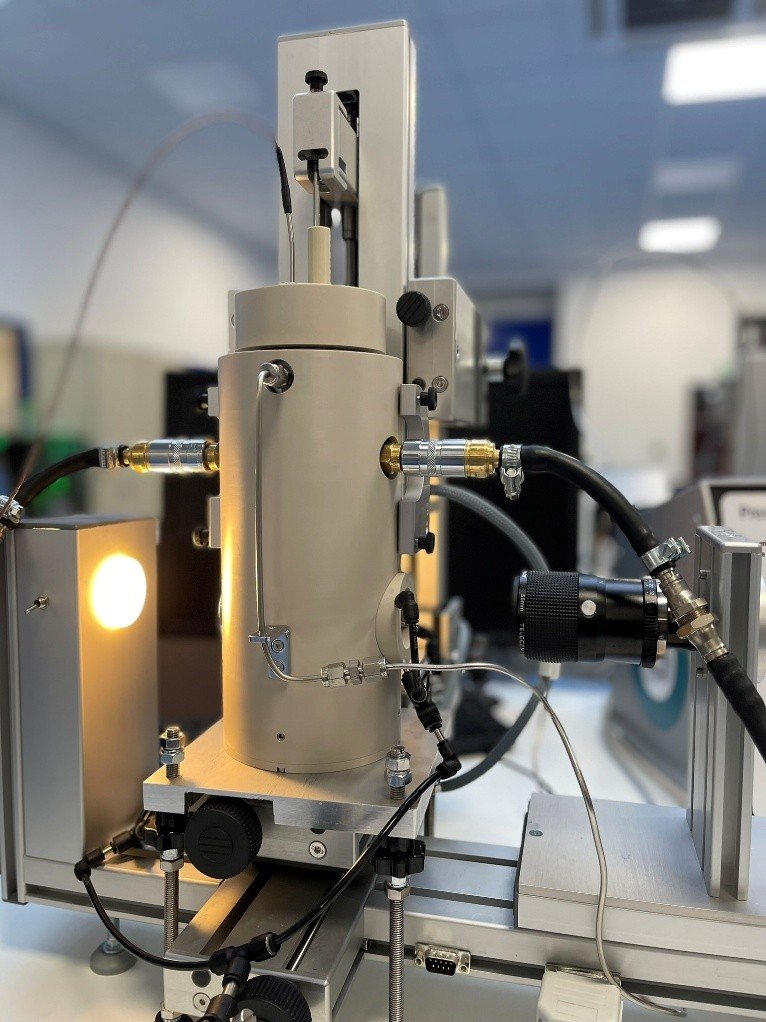
The TRACKER pressure cell is a removable module that is compatible with the standard TRACKER platform, extending the measurement range to 200°C and 200 bar. All measurement configurations — pendant drop, rising drop, sessile drop, and captive bubble — can be performed inside the cell. The syringe piston is accessible from outside the cell and can be automatically controlled, so experiments can run without opening the pressurized environment. Cell pressure is regulated through a gas control box that connects to any in-house pressure source, gas cylinder, or compressor. Temperature is measured independently with a thermocouple immersed in the liquid inside the cell and regulated by a dedicated temperature control system.
For applications requiring still higher pressures — up to 700 bar — the TRACKER HTHP is a dedicated high-pressure instrument built around a permanently integrated pressure cell with CETIM-certified design. For detailed specifications, visit the TRACKER HTHP product page.
The critical point is that the same first-principles ADSA methodology applies under all of these conditions. The measurement is no less rigorous at 200 bar or 700 bar than at ambient pressure, because the physics of the Young-Laplace equation does not change with temperature or pressure. Only the drop shape changes, and that is exactly what the TRACKER measures.


Every measurement described on this page — surface tension, interfacial tension, adsorption kinetics, interfacial rheology, surface pressure, CMC, contact angle, and wettability — comes from a single pendant or rising drop, analyzed by a single first-principles method. The TRACKER is not a collection of separate instruments packaged together. It is one platform, built around one methodology, designed to give you the complete picture of your system.
If you would like to discuss how the TRACKER can be configured for your specific application, or to see how it performs with your own samples, we would welcome the conversation.