
Precision Tensiometers and Foam Analyzers for Interface Science
Capture the complete picture — equilibrium and dynamic surface tension, interfacial rheology, foamability, and foam stability — from ambient to extreme conditions.
Liquid-liquid and liquid-gas interfaces are dynamic entities. The molecules at the interface are constantly being exchanged with those in the bulk, and their arrangement and interactions evolve over time. To understand most real-world applications, it is therefore necessary to measure more than just the equilibrium state of the interface — otherwise, you are only seeing part of the story.
Relying only on equilibrium surface tension measurements can often be misleading because 1) they tell you nothing about how long it took to achieve the equilibrium state, and 2) they do not tell you how the interface will respond to perturbations. If your formulation is sprayed, mixed, sheared, or otherwise mechanically or environmentally disturbed, understanding interfacial and surface dynamics is essential to ensuring your product performs as formulated. How quickly do surfactants adsorb to a freshly created surface? How does the interface respond when it is stretched or compressed? How do these properties evolve over the first seconds, minutes, hours, days, or at whatever timescale and under whatever mechanical conditions your application requires?
Your ability to measure these dynamic properties — adsorption and desorption kinetics, interfacial rheology, and viscoelastic response — connects laboratory measurements to real-world performance. They explain why two formulations with the same equilibrium surface tension can behave completely differently in practice.
The same holds true for foams. Observing foam height visually — whether in a beaker or a graduated cylinder — can provide a general sense of direction, but it is not quantitative. Different observers will interpret the same foam differently, and important transitions can be missed entirely. For basic screening, this may be sufficient, but for true optimization and understanding, you need deeper, more nuanced insight.
Foam behavior depends not just on chemistry but also on how the foam is generated, how liquid drains through the film network, how bubbles coarsen and rearrange, and how these processes interact. Bubble size is particularly important — it is one of the most revealing indicators of foam evolution, because changes in bubble size distribution directly reflect the drainage, coalescence, and coarsening processes that govern foam stability. This is information you simply cannot obtain by watching a foam column with the naked eye.
Reproducible foam analysis also requires reproducible foam generation. If foam creation varies from run to run, the stability data will reflect that variability — not your formulation. Controlled, consistent foam generation is the foundation of meaningful and repeatable results.
At TECLIS, we build instruments that give you the complete picture. Equilibrium and dynamic surface tension. Adsorption and desorption kinetics. Interfacial dilatational rheology. Foam generation, drainage, bubble size evolution, and stability — measured simultaneously, in real time.
Our goal is simple: to help you truly understand your system so you can make better decisions about your formulation, process, or research.
TRACKER — Surface Tension and Interfacial Rheology Analyzer
The TRACKER is a pendant drop tensiometer designed to give you access to the full range of interfacial measurements described above — not just equilibrium surface tension, but the dynamic and rheological properties that govern how your system actually performs.
A single pendant or rising drop, precisely formed and controlled, becomes your measurement platform. From that drop, the TRACKER can measure surface tension and interfacial tension as a function of time — from the moment the interface is created through equilibrium and beyond. You can track surfactant adsorption and desorption kinetics in real time, observing how quickly molecules populate a freshly created interface and how the system responds to changes in conditions. The TRACKER also automates the determination of critical micelle concentration.
By applying controlled oscillations to the drop volume, the TRACKER measures interfacial dilatational rheology — the viscoelastic modulus, elastic and viscous components, and the interface's rigidity coefficient. These are the properties that determine whether a thin film will survive mechanical stress or rupture, whether an emulsion will resist coalescence, and whether a foam will stand or collapse.
The same platform also supports sessile and captive-drop configurations for contact-angle and wettability measurements.
For applications that operate far from ambient conditions — high-pressure reservoirs, elevated-temperature processes, or aggressive chemical environments — the TRACKER can be configured for measurements under extreme pressure and temperature, using the same pendant drop methodology and analytical rigor.
For detailed specifications and configuration options, visit the TRACKER product page.
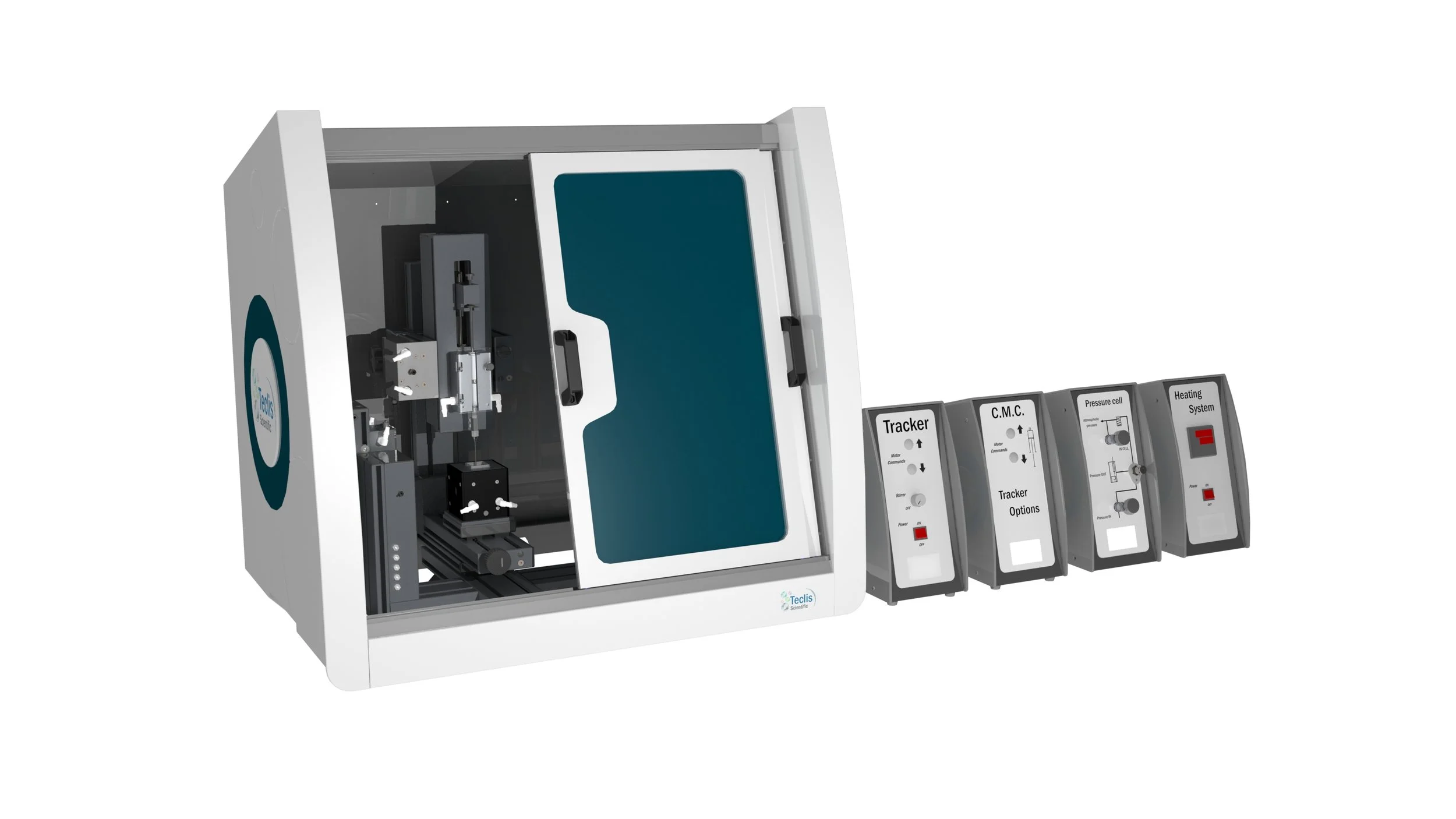
Tracker Dynamic Surface and Interfacial Measurement Example
FOAMSCAN — Foam Generation and Stability Analyzer
The FOAMSCAN picks up exactly where visual observation leaves off. Rather than relying on subjective assessments of foam height or stability, it gives you quantitative, reproducible data on every aspect of foam behavior — from the moment of generation through drainage, coarsening, and collapse.
Foam generation in the FOAMSCAN is controlled and repeatable. Gas flow rate, volume, and sparging conditions are precisely defined, so that differences in your results reflect differences in your formulation — not variability in how the foam was created. This is the foundation described above, and it is built into the instrument by design.
From there, the FOAMSCAN measures foam volume and liquid volume simultaneously and continuously, giving you real-time access to drainage kinetics and liquid fraction — the properties that govern how long a foam retains its structure and how quickly it transitions from wet to dry. Conductivity measurements provide an independent, complementary view of the drainage process.
Bubble size distribution is tracked optically throughout the experiment. Because changes in bubble size directly reflect coalescence and Ostwald ripening — the two primary mechanisms of foam destabilization — this measurement connects what you observe at the macro scale to what is actually happening at the film level.
For defoamer testing, the FOAMSCAN provides a controlled, quantitative framework for evaluating defoamer performance and efficiency, replacing subjective visual assessments with reproducible metrics that allow true formulation-to-formulation comparison.
For detailed specifications and configuration options, visit the FOAMSCAN product page.
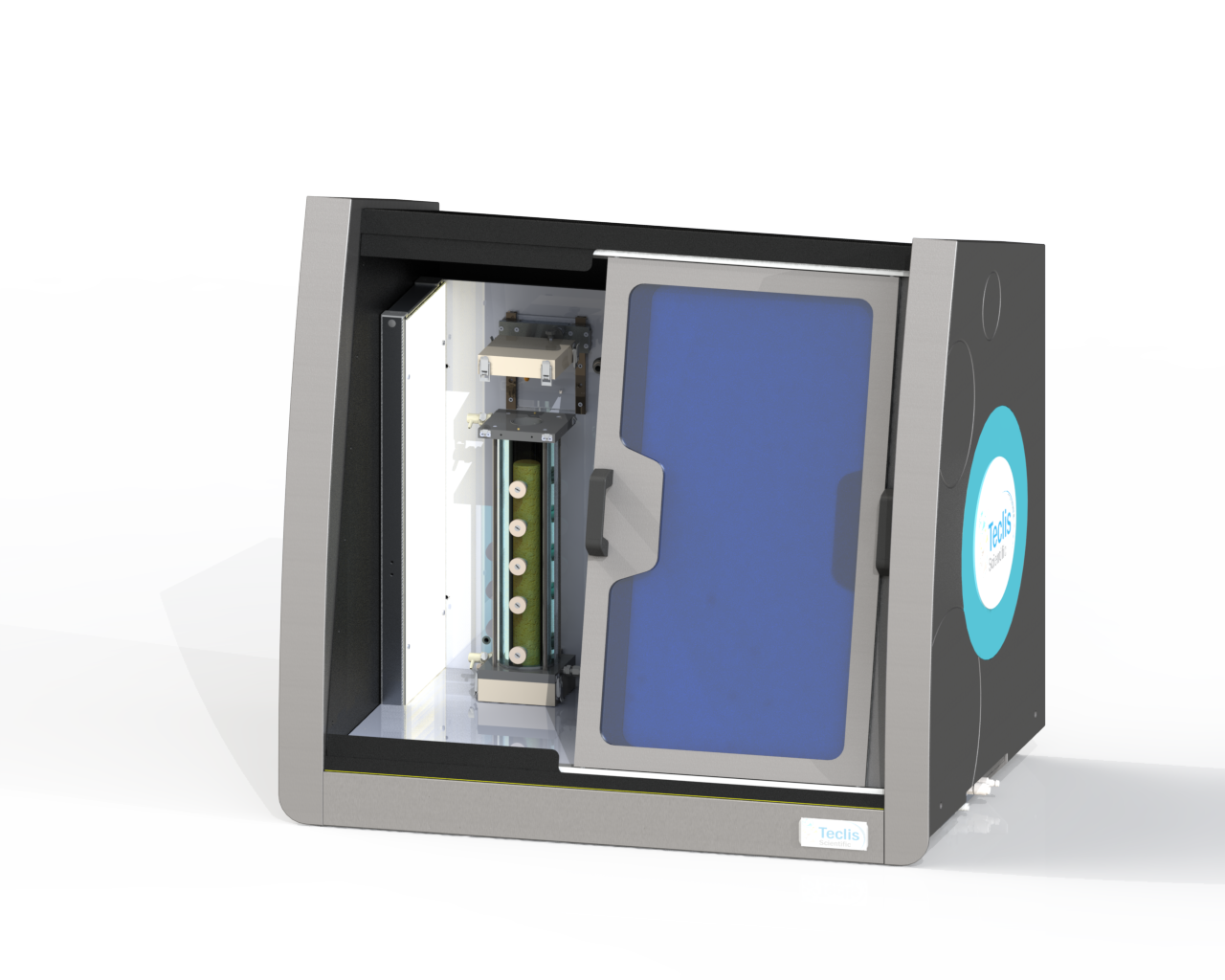
FoamScan Foam Foamability and Stability Measurement Example Using the Gas Sparging Foam Generation Method
If you are exploring new ways to characterize your system — or wondering whether your current measurements are telling you the full story — we would welcome the conversation.
Measure Precisely. Formulate Confidently.