
Tracker™ HTHP - High-Temperature High-Pressure Tensiometer for Surface Tension, Interfacial Tension, and Interfacial Rheology
First-principles method for surface tension, interfacial tension, and interfacial rheology — up to 200°C and 700 bar
Interfacial properties are not constants. Surface tension, interfacial tension, adsorption kinetics, and viscoelastic response all change — sometimes dramatically — with temperature and pressure. A surfactant system that performs well at ambient conditions may behave entirely differently at reservoir temperature and pressure, in a supercritical CO₂ environment, or in contact with a polymer melt. If the measurement is made under conditions that do not represent the application, the data may not represent the application either.
This is the fundamental problem the TRACKER HTHP is designed to solve. It is a purpose-built, standalone tensiometer that brings the full range of TRACKER measurement capabilities — surface tension, interfacial tension, adsorption and desorption kinetics, interfacial dilatational rheology, viscoelastic modulus, and static and dynamic contact angle — into environments up to 200°C and 700 bar. These are not compromised measurements adapted from an ambient instrument. The TRACKER HTHP uses the same axisymmetric drop shape analysis (ADSA) methodology, the same first-principles approach to the Young-Laplace equation, and the same analytical rigor as the standard TRACKER — because the physics does not change with temperature and pressure. Only the interface changes, and that is precisely what you need to measure.
The standard TRACKER offers a removable pressure cell module rated to 200°C and 200 bar, which serves a wide range of elevated-condition applications. The TRACKER HTHP extends significantly beyond that — up to 700 bar — for applications that require higher pressures. Enhanced oil recovery, supercritical CO₂ processes, deep-reservoir fluid characterization, petroleum and bitumen systems, and polymer melt studies all operate in pressure regimes that require this capability. The TRACKER HTHP exists because these applications demand it.
Measurement Capabilities
The TRACKER HTHP adheres to the same principles and methods as the standard TRACKER, but does so under extreme conditions:
Surface tension and interfacial tension — measured as a function of time from pendant or rising drops, using ADSA. The same time-resolved capability that captures adsorption kinetics and dynamic surface tension at ambient conditions operates identically inside the high-pressure cell.
Interfacial dilatational rheology — controlled oscillatory perturbations applied to the drop volume measure the viscoelastic modulus, elastic and viscous components, and rigidity coefficient of the interface. For applications such as enhanced oil recovery, where the mechanical properties of the interface determine whether an oil droplet will deform, coalesce, or resist displacement, these measurements under actual reservoir conditions are essential.
Contact angle and wettability — sessile-drop and captive-bubble configurations measure static and dynamic contact angles, including advancing and receding angles.
The TRACKER HTHP features a rotating platform that allows multiple drops to be placed on or under a solid surface without opening the pressure cell. This means you can characterize wettability at multiple locations on the same substrate, under the same conditions, in the same experiment — without depressurizing and repressurizing between measurements.
The Instrument
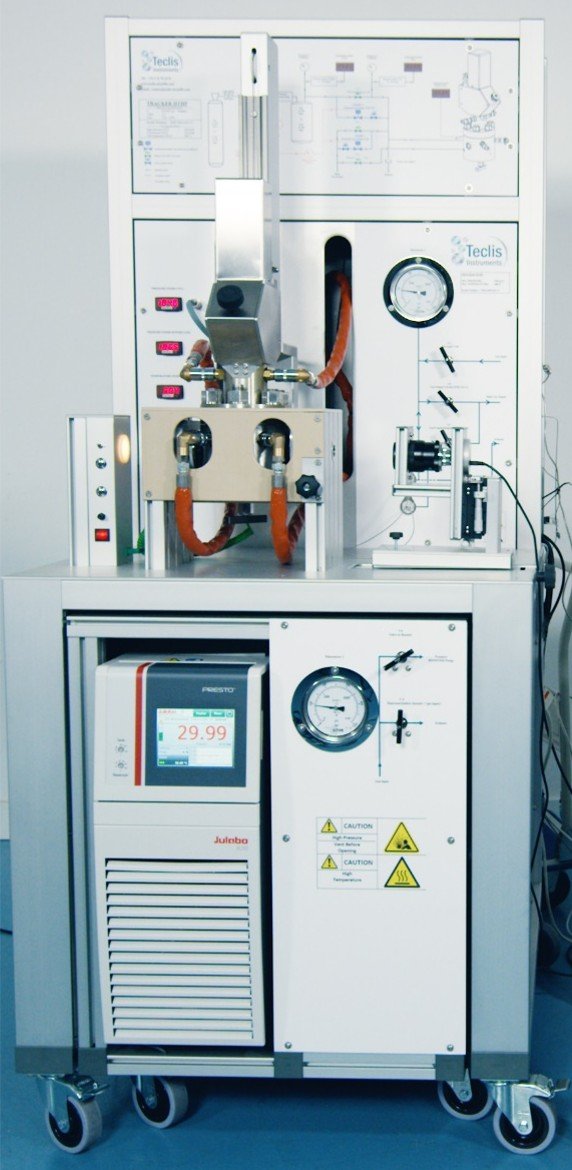
The TRACKER HTHP is a standalone instrument — not an accessory or module for the standard TRACKER. It is a self-contained, mobile system with all necessary components integrated into a single chassis: the measurement cell, optical system, temperature control, pressure regulation, and instrument control panels. It does not require any additional equipment to operate.
The high-pressure measurement cell is CETIM-certified (Centre Technique des Industries Mécaniques) and uses sapphire glass windows for optical clarity under pressure. The syringe, capillary, and cuvette are all enclosed within the pressure chamber, and the software controls liquid-drop and gas-bubble dosing with the same precision as the standard TRACKER. Cell pressure is regulated independently of temperature, and experiments can run continuously without opening the pressurized environment.
The instrument is fully compatible with all nonexplosive gases and with supercritical CO₂, making it suitable for a growing range of applications involving supercritical fluid extraction, supercritical cleaning, and CO₂-enhanced oil recovery, where the interfacial behavior of CO₂ at or above its critical point is central.
Tracker High Pressure High Temperature Tensiometer
Applications
The TRACKER HTHP serves applications where interfacial measurements under ambient conditions cannot provide the data you need:
Enhanced Oil Recovery (EOR) & Reservoir Engineering
The Tracker™ HTHP provides the high-fidelity data required to optimize complex EOR strategies, including surfactant-polymer (SP) and alkaline-surfactant-polymer (ASP) flooding. By replicating exact reservoir conditions—up to 200°C and 700 bar—researchers can precisely measure the reduction in interfacial tension (IFT) required to mobilize residual oil. Beyond simple IFT, the instrument’s ability to measure interfacial rheology is critical for EOR. Understanding the viscoelastic properties of the oil-water interface helps predict emulsion stability and the mechanical integrity of the interface during transport through porous media. This allows for the selection of chemical formulations that not only lower IFT but also ensure efficient displacement and coalescence behavior in the deep subsurface.
Carbon Capture, Utilization, and Storage (CCUS)
The success of geological carbon sequestration depends on the containment integrity of the caprock and the displacement efficiency of brine by CO₂. The Tracker™ HTHP is an essential tool for measuring the CO₂-brine-mineral contact angle under supercritical conditions. These measurements are vital for determining the "wettability" of the reservoir rock, which directly governs the capillary trapping mechanism and the formation's long-term storage capacity.
Hydrogen Storage and Transport
As the energy transition accelerates, understanding the interfacial behavior of Hydrogen (H₂) in underground salt caverns or depleted gas reservoirs is paramount. The Tracker™ HTHP enables the study of hydrogen-brine-rock interactions at high pressure, helping to predict gas fingering and storage losses. Characterizing the surface tension of hydrogen-rich systems ensures that storage sites remain secure and that withdrawal rates are optimized for the emerging hydrogen economy.
Geothermal Energy & Mineral Scaling
In high-enthalpy geothermal systems, the interaction between mineral-rich geothermal fluids and rock surfaces can lead to significant scaling and reduced permeability. Using the Tracker™ HTHP to perform dynamic contact angle measurements at extreme temperatures helps developers understand how scale inhibitors and heat-transfer fluids interact with the formation. This data is crucial for maintaining the long-term flow rates and thermal efficiency of geothermal power plants.
Polymer Melts & Advanced Manufacturing
The processing of thermoplastic polymers, composites, and adhesives occurs at temperatures far above the capabilities of standard tensiometers. The Tracker™ HTHP enables the measurement of surface tension and contact angle of molten polymers at temperatures up to 200°C. This data is critical for optimizing industrial processes like injection molding, extrusion, and additive manufacturing (3D printing), where the "wetting" of the melt onto a substrate or fiber reinforcement determines the mechanical integrity of the final part. Beyond static measurements, the instrument’s ability to operate under pressure allows researchers to study the effect of dissolved gases (like CO₂ or N₂) on the surface tension of the melt. This is essential for the development of polymer foams, as the interfacial tension governs cell nucleation and growth. By providing accurate data on adsorption kinetics and interfacial rheology at processing temperatures, the Tracker™ HTHP helps manufacturers reduce defects such as delamination and poor fiber impregnation in high-performance composites.
Supercritical Fluid Extraction (SFE) & Green Chemistry
Supercritical CO₂ is a powerful, non-toxic alternative to organic solvents, but its efficiency depends entirely on its ability to penetrate and interact with the target material. The Tracker™ HTHP is an essential tool for optimizing SFE processes—such as decaffeination, essential oil extraction, and nutraceutical production—by measuring the interfacial tension (IFT) between the supercritical fluid and the extractable oils. By precisely controlling pressures up to 700 bar, researchers can determine the "solubility parameters" and wetting behavior required to maximize yield and purity. Understanding how the IFT changes near the critical point allows for the fine-tuning of extraction cycles, reducing processing time and solvent waste in the production of high-value compounds like CBD, flavors, and fragrances.
High-Pressure Food Processing (HPP) & Emulsion Science
In the food industry, High-Pressure Processing (HPP) is used to extend shelf life and ensure safety without the nutrient loss associated with heat. However, extreme pressures can destabilize complex emulsions, such as dairy products, sauces, and plant-based milks. The Tracker™ HTHP allows food scientists to study interfacial rheology and film stability under actual processing conditions.
Unlike bulk rheology tools that measure flow, the Tracker™ HTHP focuses on the "skin" of the droplet. It measures how proteins and emulsifiers behave at the interface when subjected to several hundred bars of pressure. This data is critical for preventing phase separation and ensuring that products maintain a consistent texture and "mouthfeel" from the factory to the consumer. Whether developing clean-label stabilizers or optimizing high-pressure homogenization, the Tracker™ HTHP provides the molecular-level insights necessary for innovation in food science.

Tracker HTHP Surface Tension Measurement of a Water Drop in Nitrogen at a Temperature of 65 Celsius and a Pressure of 350 bar

If you are working with interfaces under extreme conditions and want to discuss how the TRACKER HTHP can be configured for your application, we would welcome the conversation.
For applications within the 200°C / 200 bar range, the standard TRACKER with its removable pressure cell module may be the right solution — visit the TRACKER product page for details.