
When a Simple Surface Tension Measurement Is Not Enough — What Direct Laplace Pressure Measurement Reveals About Your Interface
All standard surface and interfacial tension analysis — regardless of method — rests on a shared assumption: that the interface between two phases behaves as a liquid surface. This assumption is embedded in the physics. The Young-Laplace equation, which describes the pressure difference across a curved interface as a function of surface tension and curvature, applies to liquid interfaces. When the assumption holds, the methods built on it are rigorous and reliable. When it does not, the measurements can become misleading — and in many cases, there is no obvious indication that anything has gone wrong.
The pendant-drop method is uniquely positioned to detect when this assumption fails, because of what it can measure beyond surface tension. Standard drop shape analysis fits the observed profile of a pendant drop or bubble to a theoretical curve derived from the Young-Laplace equation. The surface tension is the value that produces the best fit. It is, as Erbil describes it, an absolute measurement — first-principles, requiring no calibration against reference liquids and no mechanical contact with the interface.
But there is a class of systems — important, practically relevant systems — in which the interface does not remain a liquid surface.
Proteins adsorb and unfold at air-water interfaces, often forming networked films that develop mechanical rigidity over time. Asphaltenes accumulate at oil-water interfaces and, under the right conditions of solvent quality and surface coverage, transition from a fluid layer into interfacial rigid skins — what petroleum engineers have recognized since the 1950s. Nanoparticles jam at interfaces into solid-like monolayers. Polymers assemble into structured capsule walls. In every one of these cases, the interface at some point stops behaving as a liquid and starts behaving as a membrane — a solid film with its own mechanical properties that are no longer described by surface tension alone.
When this transition occurs, the drop or bubble shape is no longer Laplacian. The profile deviates from what the Young-Laplace equation predicts, and the standard curve-fitting procedure either produces an inaccurate surface tension value or fails to converge altogether. The problem is that in many cases, this deviation develops gradually. The fit may still converge, but the number it returns is no longer the correct surface tension. It is an artifact of fitting a liquid model to a solid-like or membrane-like interface. You get a number, but the number is wrong, and there is no internal check within standard drop shape analysis to tell you so.
This is the problem that direct Laplace pressure measurement solves.
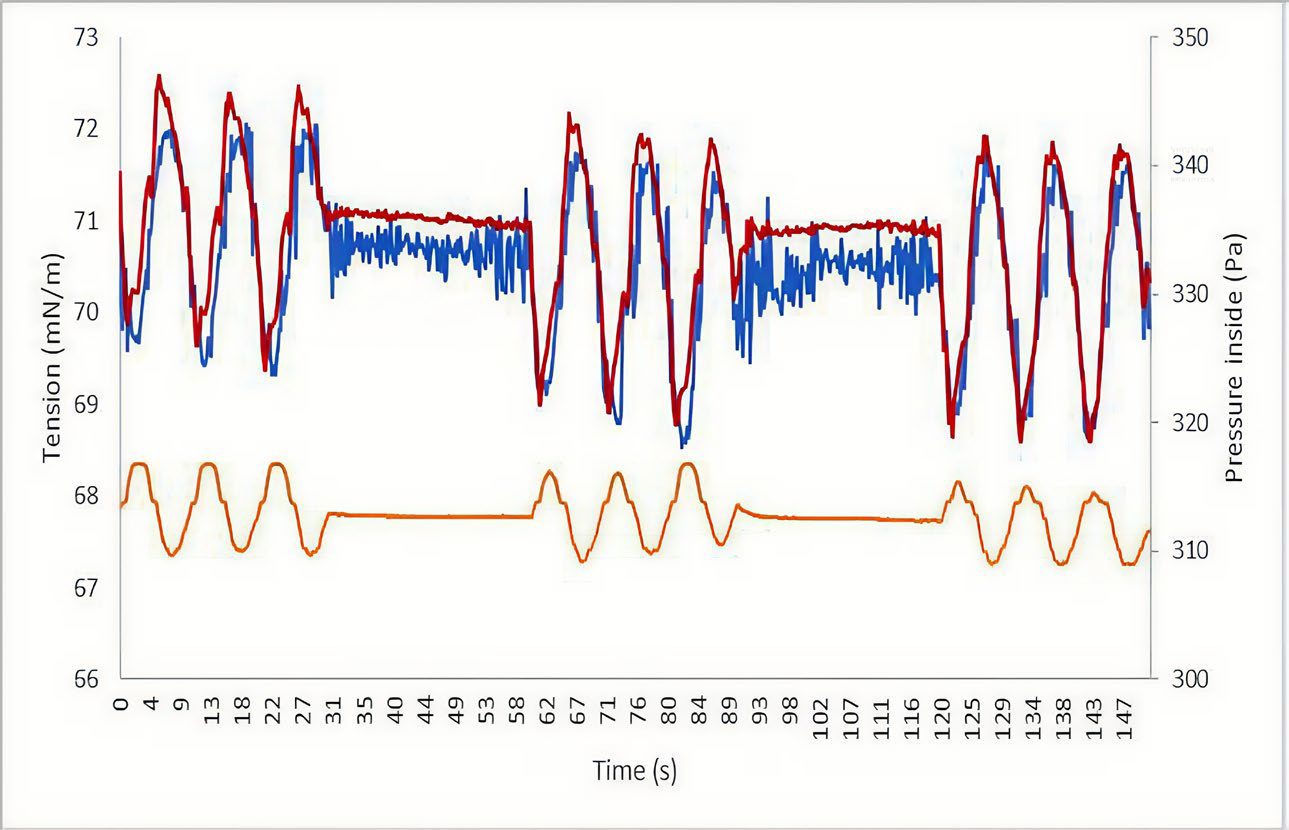
The concept is straightforward. In addition to analyzing the shape of the bubble optically — the standard TRACKER measurement — a pressure sensor measures the hydrostatic pressure inside the bubble directly, in real time. From the measured pressure and the height of the bubble, the software calculates a second, independent surface tension value: the apex tension. You now have two determinations of surface tension from the same bubble, in the same experiment, derived from two different physical principles. One comes from the shape of the interface. The other comes from the pressure across it.
When the two values agree, the interface is Laplacian. It is behaving as a liquid surface, the Young-Laplace equation fully describes the system, and the surface tension from drop shape analysis is reliable. When the two values diverge, the interface is no longer Laplacian. Something has changed — a structured film has formed, the interface has developed mechanical rigidity, and the shape of the bubble now reflects that rigidity rather than surface tension alone.
The figure below illustrates the three simultaneous measurements from a single experiment. Surface tension determined by image analysis of the bubble shape (blue) and apex tension calculated from the direct pressure measurement and bubble height (red) are plotted on the left axis in mN/m. Pressure inside the bubble (orange) is plotted on the right axis in Pa. The oscillatory pattern reflects controlled sinusoidal perturbations applied to the bubble volume. In this experiment, the surface tension and apex tension track each other closely throughout — confirming that the interface remains Laplacian and the standard drop shape analysis is valid. When a structured film begins to form at the interface, these two values diverge, and the divergence itself becomes the measurement — a direct, real-time diagnostic of membrane formation.
This is not an incremental refinement of the surface tension measurement. It is a fundamentally different piece of information. Standard interfacial dilatational rheology — the oscillatory measurement of the viscoelastic modulus — tells you how stiff the interface is. That is valuable. But it still operates within the Laplacian framework; it still assumes the interface is a liquid surface whose tension changes in response to area changes. The pressure sensor tells you when that framework breaks down — when the interface has undergone a phase transition from a liquid surface to a solid-like membrane. These are different questions, and for systems where that transition occurs, the pressure measurement is the direct diagnostic.
Consider the examples.
In crude oil systems, asphaltenes adsorb at the oil-water interface and, at sufficiently high surface coverage or in poor solvent conditions, form rigid films that stabilize water-in-oil emulsions. These emulsions resist conventional demulsification and cause significant processing problems in upstream and downstream operations. Multiple research groups have shown that the onset of this rigidity corresponds precisely to the point where the drop shape deviates from the Laplacian profile — at roughly 80% surface coverage, the Young-Laplace fit begins to fail. With a pressure sensor, you do not need to infer this from fit quality. You see the surface tension and the apex tension diverge, and you know the transition has occurred. You know when it occurred, and you can correlate it to the adsorption time, the concentration, or the solvent conditions that produced it.
In food science and pharmaceutical formulations, proteins at air-water and oil-water interfaces form viscoelastic films that can become rigid enough to exhibit wrinkling and buckling under compression. The mechanical properties of these protein films determine whether foam lamellae survive, whether emulsion droplets resist coalescence during processing, and whether therapeutic protein formulations maintain their integrity during manufacturing. The question is not just how stiff the protein film is — it is whether the film has crossed the threshold from a deformable, liquid-like layer to a rigid membrane. That threshold is what determines whether your foam survives pasteurization, whether your emulsion breaks during homogenization, or whether your biologic aggregates at the air-water interface during fill-finish operations.
In particle-stabilized systems — Pickering emulsions and foams — nanoparticles or microparticles adsorb at interfaces and can jam into rigid monolayers. The onset of jamming is a phase transition, and it fundamentally changes the behavior of the interface. A jammed particle monolayer does not respond to compression and expansion the way a surfactant-laden liquid surface does. The Laplacian assumption fails, and standard drop shape analysis cannot capture what is happening. The pressure sensor can.
The common thread across all of these is that the pressure sensor answers a question that standard rheological measurements — even good ones — do not address: is the interface still a liquid surface, or has it become something else? While at first glance this may seem a niche concern, it is not. Anyone working with proteins, asphaltenes, polymers, particles, or complex mixtures at interfaces is working with systems that can undergo this transition. For simple surfactant systems well below saturation, the answer is almost always yes — the interface remains liquid-like, and the pressure sensor is not essential. But for any system where the interface can become structured, the ability to detect that transition directly, quantitatively, and in real time is the measurement that changes the interpretation of everything else. The question is whether you can detect and accurately measure it.
The TRACKER Pressure Sensor module provides exactly this capability. It is composed of the pressure sensor itself and a luer lock crossed manifold that connects to the syringe, and it is compatible with the TRACKER S, TRACKER H, and TRACKER CMC configurations. Combined with the Piezoelectric module, the pressure sensor also enables surface tension measurement at high oscillation frequencies, providing an independent determination of surface tension that extends the frequency range of the rheological measurement beyond what drop shape analysis alone can achieve.
For scientists working with interfaces that may not remain liquid-like — and that includes a wider range of systems than most researchers initially assume — this is a measurement worth understanding.
This article is part of the TECLIS America technical resource library. For information about the TRACKER tensiometer and its full range of measurement capabilities, visit the TRACKER product page.